BALI never truly sleeps. Beneath the buzz of beach club music in Canggu and the aroma of artisan coffee in Ubud, an ancient pulse beats at a frequency only those willing to duck can hear. In the mist-shrouded villages on the hillsides of Tabanan, the air contains not only oxygen but also prayers frozen in the atmosphere.
This is where this story begins—a narrative about the fine line between modern aesthetics and the untouched sacred.
The Light Hunter
Julian Adrian is the definition of 21st-century digital success. With two million followers on Instagram, his profile is a curation of life’s beauty: floating breakfasts in the Maldives, brutalist architecture in Berlin, and now, exotic mysticism in Bali. For him, the world is a canvas, and he is the paintbrush.
“Bali has been photographed too often, but I wanted to find something… raw,” Julian told Wayan Sudarma, the local guide who accompanied him that morning. They sat in a small warung, sipping strong Balinese coffee as the first rays of sunlight filtered through the coconut fronds.
Wayan, a middle-aged man with facial features as calm as a lake, smiled faintly. “There are places that don’t like to be photographed, Julian. They prefer to be experienced.”
Julian chuckled, his fingers fiddling with his Leica camera. “That’s fine for a caption, Wayan. But my audience needs visuals. I heard about that giant tree—Banyan Tree, or something similar inland. I want to go there.”
Wayan paused for a moment. There was a subtle shift in his eyes, a kind of unspoken warning. “That tree isn’t just wood and leaves. It’s a protector. It’s a stana (abode) for the unseen.”
Towards the Green Heart
The journey to the site took them along narrow, winding roads, cutting through the humid rainforest. The air grew cooler, and the scent of incense began to creep into the car cabin, mingling with the sharp scent of wet earth.
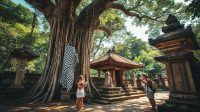
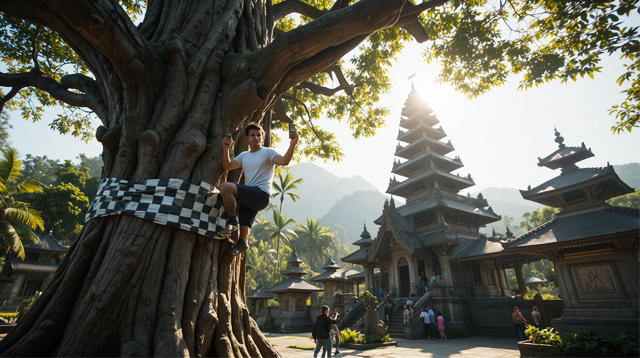
When they arrived, the sight was truly magical. A giant Banyan tree stood majestically, its massive roots gripping the earth like giant fingers, while its branches hung down like silver curtains. Beneath its shade, a small temple with moss-covered stone shrines stood majestically. A poleng (black and white chekered) cloth wrapped around the tree trunk, signifying the existence of the niskala—the unseen world.
“Amazing,” Julian whispered. He immediately imagined the composition of his photo: himself standing on one of the large branches jutting toward the temple, with sunlight filtering through the leaves in the background. “This will be this year’s content.”
“Don’t climb too high, Julian,” Wayan warned, his face tense. “Just stay below. This tree is ‘waking up.’”
However, for an influencer, risk is the currency of popularity. While Wayan was busy preparing a small offering in the lower courtyard as a sign of permission, Julian slipped away. He climbed nimbly, his expensive shoes treading on the rough bark.
A Broken Moment
Up there, the air felt different. The cold was piercing, and there was a low humming sound that made his ears ring. Julian didn’t care. He stood on a large branch that stretched directly above a recently restored stone shrine.
“One more photo,” he muttered.
Suddenly, the forest fell silent. The birds stopped chirping. The wind, which had been blowing gently, suddenly died. In the eerie silence, there was a sharp crack—like the sound of bones breaking.
Julian lost his balance. The large branch he was standing on, which had seemed sturdy and healthy, suddenly snapped for no botanical reason. Julian fell, but luckily caught on a lower branch. However, the large, broken branch slammed directly into the shrine below.
Crash!
The black palm fiber roof of the shrine shattered, and its stone pillars cracked badly. Julian trembled, his face pale. When he looked down, he saw Wayan standing frozen, staring at the ruins with an expression of profound fear.
It wasn’t just the physical damage, but something much greater had been disturbed.
Trial Under the Shade of a Tree
That same afternoon, the tranquil atmosphere in the village turned tense. Julian was taken to the village hall. There, the Prajuru (traditional village administrators) had gathered. The atmosphere was dim, illuminated only by a few yellow lamps and the pungent scent of incense.
An old man with a pristine batik headband (udeng), the Bendesa Adat, stared at Julian with a gaze that seemed to penetrate the soul.
“You haven’t just broken a piece of wood, my son,” the Bendesa’s voice was deep and authoritative. “You’ve injured the ‘home’ we’ve guarded for seven generations. This tree is our antenna to the spiritual realm and our ancestors. With the fall of the tree branch on the shrine, and the sanctity of this place has been desecrated.”
Julian tried to defend himself. “I didn’t mean to. I will pay for the damage. How much? One million? Five million?”
The atmosphere suddenly fell silent. Wayan, standing in the corner of the room, shook his head slowly.
“Here, damage isn’t measured in mere rupiah,” the village head continued. “You must pay for the complete physical repair of the shrine. But more importantly, you are obligated to pay for the Mecaru and Guru Piduka apologetic ceremonies. This is a purification ceremony to apologize to the inhabitants of the spiritual realm so that their anger won’t bring disaster to our village.”
Julian was stunned when he heard the total cost. It wasn’t just the tens of millions of rupiah, but also the complexity of the rituals that had to be performed: elaborate offerings, the slaughter of sacred sacrificial animals, and the presence of dozens of traditional leaders.
Mysticism Becomes Real
During the three days of preparation for the ceremony, Julian was forbidden to leave the village. He stayed at a simple homestay owned by a resident. It was here that Julian’s urban arrogance began to crumble.
Every night, he had the same dream: he felt his body wrapped around cold tree roots, and a disembodied voice whispered in a language he didn’t understand, but its meaning was clear: Humans are just guests, don’t act like owners.
He also witnessed how the entire village worked together. The women meticulously woven coconut leaves, the men re-carved the broken rock. There was no outburst of anger toward Julian, only firmness and devotion to tradition.
“We don’t hate you,” said a village youth as Julian helped him carry bamboo. “We’re just afraid. If this natural balance is disturbed, we will bear the consequences. The rice fields could fail, or an epidemic could strike. For us, the mystical is reality.”
Prajuru Meeting: A New Fortress
In the midst of the procession, the village Prajuru held an emergency meeting at the village temple. Julian’s incident became the catalyst for major changes in tourism management there. They realized that their village’s beauty was a magnet, but without protection, that magnet would destroy itself.
“Starting today,” the Bendesa tapped his wooden staff on the floor, “every tourist entering the sacred area must be accompanied by a Pecalang (traditional guardian) or a certified village guide. No one can wander alone without understanding etiquette anymore.”
They then formulated a written guide, a manifesto on how humans should interact with Tabanan’s natural environment.
Village Tourist Ethics Guide (The Sacred Code):
(1) Dress and Behavior
A sarong and shawl must be worn when entering the temple area or sacred trees. No foul language or shouting is permitted.
(2) Physical Restrictions
Climbing sacred structures (pelinggih), temple walls, or sacred trees is prohibited. Beauty does not need to be touched to be appreciated.
(3) Prohibited Periods
Women who are menstruating are prohibited from entering the main temple area to maintain the sanctity of the ritual.
(4) Trash and Plastic
Nature is the body of the gods. Littering is a direct insult to the Almighty.
(5) Photography Permit
For commercial use or heavy equipment (drones, large tripods), reporting and paying a conservation donation are required.
Self-Purification
The day of the ceremony arrived. Julian stood amidst the smoke of incense and the tinkling of the priest’s bell. He felt small. As the tirta (holy water) sprinkled on his forehead, he felt a heavy weight slowly lift from his shoulders. He was no longer just an influencer chasing likes; he was a human being who had just been reminded of his place in the universe.
The broken branch had now been cleaned, and the new shrine stood sturdier with its carvings still fresh. However, the cracks in the ground seemed to serve as a permanent reminder.
Before leaving the village, Julian made an additional donation for the village children’s education. He didn’t post a photo of himself atop the tree. Instead, he posted a black-and-white photo: his rough hand holding the Bendesa’s wrinkled hand.
The caption was short but profound: “Some places are not meant to be conquered, but to be worshipped.” Thank you, Bali, for teaching me how to see again.
Travel Notes: Responsible Beauty
Julian Adrian’s journey provides valuable lessons for us all. Bali, with all its mystical charm, is more than just an aesthetic photo backdrop. Behind every large tree, behind every moss-covered stone, there is a prayer and a breathing history.
As intelligent and ethical travelers, we have a responsibility to maintain the integrity of the destinations we visit. The true luxury of travel lies not in how many places we ‘occupy,’ but in how deeply we are able to respect the soul of the place.
The next time you visit Bali, remember the story of the broken tree. Listen to its whispering wind, respect its boundaries, and let its magic remain, intact and unharmed, for those who come after us. For ultimately, we are only temporary pilgrims in this land of the gods. (*)